Spring概述,IOC的几种示例程序:通过id获取对象;通过类型获取对象;通过构造方法参数名;index属性指定;根据参数类型注入;
Spring概述
- Spring是一个开源框架
- Spring为简化企业级开发而生,使用Spring开发可以将Bean对象,Dao组件对象,Service组件对象等交给Spring容器来管理,这样使得很多复杂的代码在Spring中开发却变得非常的优雅和简洁,有效的降低代码的耦合度,极大的方便项目的后期维护、升级和扩展。
- Spring是一个IOC(DI)和AOP容器框架。
- Spring的优良特性
- 非侵入式:基于Spring开发的应用中的对象可以不依赖于Spring的API
- 控制反转:IOC——Inversion of Control,指的是将对象的创建权交给Spring去创建。使用Spring之前,对象的创建都是由我们自己在代码中new创建。而使用Spring之后。对象的创建都是由给了Spring框架。
- 依赖注入:DI——Dependency Injection,是指依赖的对象不需要手动调用setXX方法去设置,而是通过配置赋值。
- 面向切面编程:Aspect Oriented Programming——AOP
- 容器:Spring是一个容器,因为它包含并且管理应用对象的生命周期
- 组件化:Spring实现了使用简单的组件配置组合成一个复杂的应用。在 Spring 中可以使用XML和Java注解组合这些对象。
- 一站式:在IOC和AOP的基础上可以整合各种企业应用的开源框架和优秀的第三方类库(实际上Spring 自身也提供了表述层的SpringMVC和持久层的Spring JDBC)。
Spring的模块介绍
Spring框架分为四大模块:
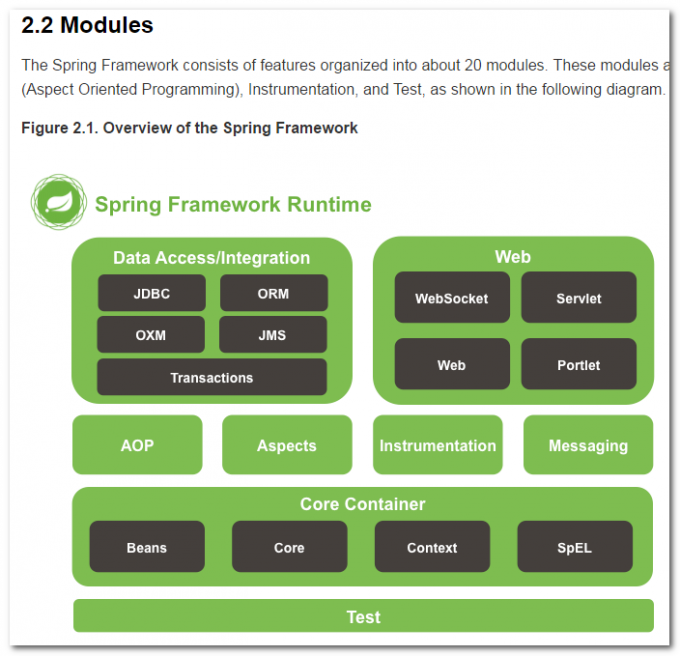
Core核心模块。
负责管理组件的Bean对象 spring-beans-4.0.0.RELEASE.jar spring-context-4.0.0.RELEASE.jar spring-core-4.0.0.RELEASE.jar spring-expression-4.0.0.RELEASE.jar
面向切面编程
spring-aop-4.0.0.RELEASE.jar
spring-aspects-4.0.0.RELEASE.jar
数据库操作
spring-jdbc-4.0.0.RELEASE.jar
spring-orm-4.0.0.RELEASE.jar
spring-oxm-4.0.0.RELEASE.jar
spring-tx-4.0.0.RELEASE.jar
spring-jms-4.0.0.RELEASE.jar
Web模块
spring-web-4.0.0.RELEASE.jar
spring-webmvc-4.0.0.RELEASE.jar
spring-websocket-4.0.0.RELEASE.jar
spring-webmvc-portlet-4.0.0.RELEASE.jar
安装Spring的插件
网上有比较多的eclipse添加spring插件的方式,读者可自行从网络上获取下载经验。
IOC依赖注入
IOC定义
IOC 全称指的是 Inverse Of Control 控制反转。
控制反转指的是对象的创建权力被反转了。
使用Spring以前,对象都是自己new去创建。
使用Spring之后。对象都通过配置Spring的配置文件,然后由Spring容器负责创建。
DI的定义
DI 指的是Dependency Injection 。是依赖注入的意思。
没有使用Spring的时候对依赖对象的赋值。
public class BookService {
private BookDao bookDao;

public void setBookDao( BookDao bookDao ){
this.bookDao = bookDao;
}

}
使用了Spring之后,就不需要再通过编码来实现对依赖对象的赋值。而是通过配置。
第一个IOC示例程序 – 通过id获取对象
实验1:通过IOC容器创建对象,并为属性赋值
第一步,创建一个Java工程
并导入jar包
创建config源码目录
准备JavaBean对象
public class Person {
	private Integer id;
	private String name;
	private String phone;
	private Integer age;
创建applicationContext.xml配置文件,并配置bean对象
<?xml version="1.0" encoding="UTF-8"?>
<beans xmlns="http://www.springframework.org/schema/beans"
	xmlns:xsi="http://www.w3.org/2001/XMLSchema-instance"
	xsi:schemaLocation="http://www.springframework.org/schema/beans http://www.springframework.org/schema/beans/spring-beans.xsd">

	<!--
		bean标签用来配置一个Bean(bean就是对象)
			class属性设置你要配置的Bean的全类名
			id属性设置一个唯一的标识
	 -->
	<bean id="p1" class="com.ncu.zte.beans.Person">
		<!-- property标签配置属性值
				name设置属性名
				value属性设置值
		 -->
		<property name="id" value="1" />
		<property name="name" value="国哥又有机会帅了" />
		<property name="age" value="18" />
		<property name="phone" value="18610541354" />
	</bean>

</beans>
测试的代码:
public class test {

	@Test
	public void test1() throws Exception {
		// applicationContext.xml是Spring的配置文件,
		// 我们需要先有一个Spring容器(Spring IOC 容器),再从容器中获取配置的bean对象
		//ApplicationContext接口表示Spring IOC容器
		// Spring容器(Spring IOC容器) 在初始化的时候需要一个配置文件
		// ClassPathXmlApplicationContext表示从Classpath类路径下加载你指定的配置文件名,生成Spring容器
		ApplicationContext applicationContext = new ClassPathXmlApplicationContext("applicaionContext.xml");
		// getBean是从Spring容器中获取指定id值的bean对象
		Person person = (Person) applicationContext.getBean("p1");

		System.out.println(person);
	}
}
一些问题
- FileSystemXmlApplicationContext怎么用?
答:跟使用JavaSE的相对路径一样
// 从文件系统路径中加载指定的xml配置文件生成Spring容器
ApplicationContext applicationContext = new FileSystemXmlApplicationContext("config/applicaionContext.xml");
- Bean是在什么时候被创建的?
在创建ApplicatiocnContext容器对象的时候创建(默认)
- 如果调用getBean多次,会创建几个?
默认创建同一个
常见的错误
指定的id不存在。找不到bean对象。
IOC示例程序 – 通过类型获取对象(重点)
实验2:根据bean的类型从IOC容器中获取bean的实例★
applicationContext.xml配置文件:
<!--
		bean标签用来配置一个Bean(bean就是对象)
			class属性设置你要配置的Bean的全类名
			id属性设置一个唯一的标识
	 -->
	<bean id="p1" class="com.atguigu.pojo.Person">
		<!-- property标签配置属性值
				name设置属性名
				value属性设置值
		 -->
		<property name="id" value="1" />
		<property name="name" value="国哥又有机会帅了" />
		<property name="age" value="18" />
		<property name="phone" value="18610541354" />
	</bean>
	<bean id="p2" class="com.atguigu.pojo.Person">
		<!-- property标签配置属性值
				name设置属性名
				value属性设置值
		 -->
		<property name="id" value="2" />
		<property name="name" value="国哥帅2次" />
		<property name="age" value="18" />
		<property name="phone" value="18610541354" />
	</bean>
测试代码:
@Test
public void test2() throws Exception {
	// 先创建Spring容器对象
	ApplicationContext applicationContext = new ClassPathXmlApplicationContext("applicaionContext.xml");
	// 通过类型获取Spring容器中的对象
	/**
	 * 如果通过类型查找bean对象。<br/>
	 * 	1、找到一个就直接返回<br/>
	 *  2、找到两个就报错<br/>
	 *  3、没有找到也报错
	 */
	Person person = applicationContext.getBean(Person.class);

	System.out.println( person );
}
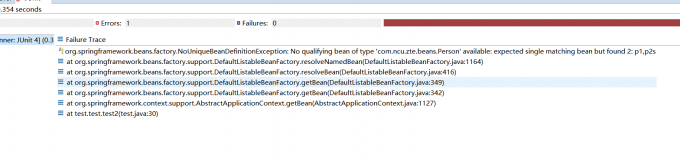
常见错误说明:
当在applicationContext.xml配置文件中。有多个同Person.class类型实现的时候。
IOC示例程序 – 通过构造方法参数名注入值
实验3:通过构造器为bean的属性赋值
applicationContext.xml配置文件:
- constructor-arg 标签是指通过构造器赋值
- name设置构造器的参数名
-
value设置构造器对应的参数值
测试代码:
@Test
public void test3() throws Exception {
	// 先创建Spring容器对象
	ApplicationContext applicationContext = new ClassPathXmlApplicationContext("applicaionContext.xml");

	Person p3 = (Person) applicationContext.getBean("p3");

	System.out.println(p3);

}
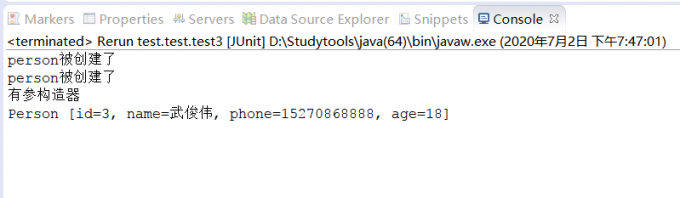
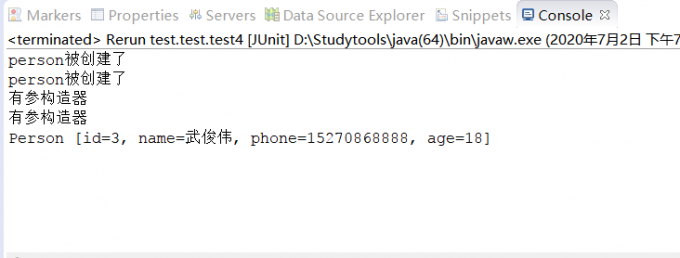
因为p1,p2都是调用了无参构造器进行赋值,p3是通过有参构造器进行的赋值,所以运行结果如下:
IOC示例程序 – index属性指定参数的位置
实验4:通过index属性指定参数的位置
applicationContext.xml配置文件:
	<!-- Person(Integer id, String name, String phone, Integer age)  -->
	<!-- idnex属性设置参数的索引
			0 第一个参数
			1 第二个参数
			…… 以此类推
			n 第n+1个参数
	 -->
applicationContext.xml配置文件:
<bean id="p4" class="com.ncu.zte.beans.Person">
	<constructor-arg index="0" value="3"></constructor-arg>
	<constructor-arg index="1" value="武俊伟"></constructor-arg>
	<constructor-arg index="2" value="15270868888"></constructor-arg>
	<constructor-arg index="3" value="18"></constructor-arg>
</bean>
测试代码:
@Test
public void test4() throws Exception {
	// 先创建Spring容器对象
	ApplicationContext applicationContext = new ClassPathXmlApplicationContext("applicaionContext.xml");

	System.out.println( applicationContext.getBean("p4") );

}
IOC示例程序 – 根据参数类型注入
实验5:根据参数类型注入
有两上Person的有参构造器:
public class Person {

	private Integer id;
	private String name;
	private String phone;
	private Integer age;

	public Person(Integer id, String name, String phone, Integer age) {
		super();
		System.out.println("有参构造器");
		this.id = id;
		this.name = name;
		this.phone = phone;
		this.age = age;
	}

	public Person(Integer id, String name, Integer age, String phone) {
		super();
		System.out.println("有参构造器");
		this.id = id;
		this.name = name;
		this.phone = phone;
		this.age = age;
	}
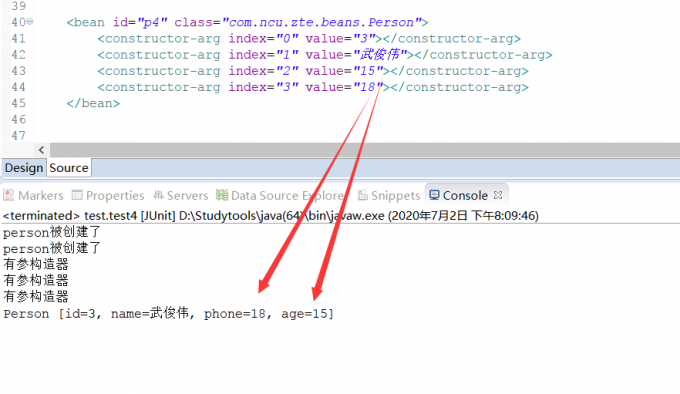
applicationContext.xml配置文件
<bean id="p5" class="com.ncu.zte.beans.Person">
	<constructor-arg index="0" value="3"></constructor-arg>
	<constructor-arg index="1" value="武俊伟" ></constructor-arg>
	<constructor-arg index="2" value="15" ></constructor-arg>
	<constructor-arg index="3" value="18" ></constructor-arg>
</bean>
测试结果:
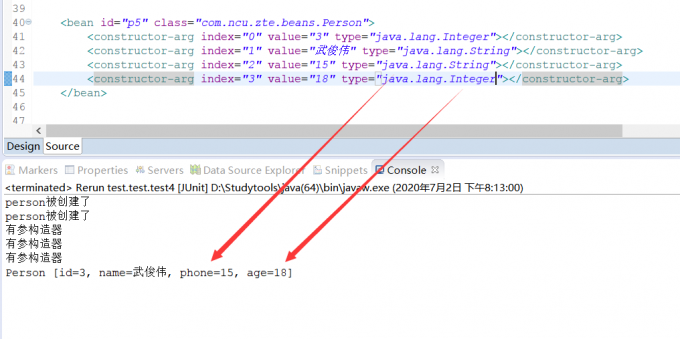
<bean id="p5" class="com.ncu.zte.beans.Person">
	<constructor-arg index="0" value="3" type="java.lang.Integer"></constructor-arg>
	<constructor-arg index="1" value="武俊伟" type="java.lang.String"></constructor-arg>
	<constructor-arg index="2" value="15" type="java.lang.String"></constructor-arg>
	<constructor-arg index="3" value="18" type="java.lang.Integer"></constructor-arg>
</bean>
测试结果: